Research
What insurance lead company terms really say
Most agents fund a lead account without reading the buyer agreement. We get it, nobody reads those, which is exactly why we sat down and read all of them. In October 2026 we went through the buyer terms, return policies and purchase agreements of the 23 insurance lead companies we cover and coded what each one says on 30 points that touch an agent’s money and risk.
Key findings
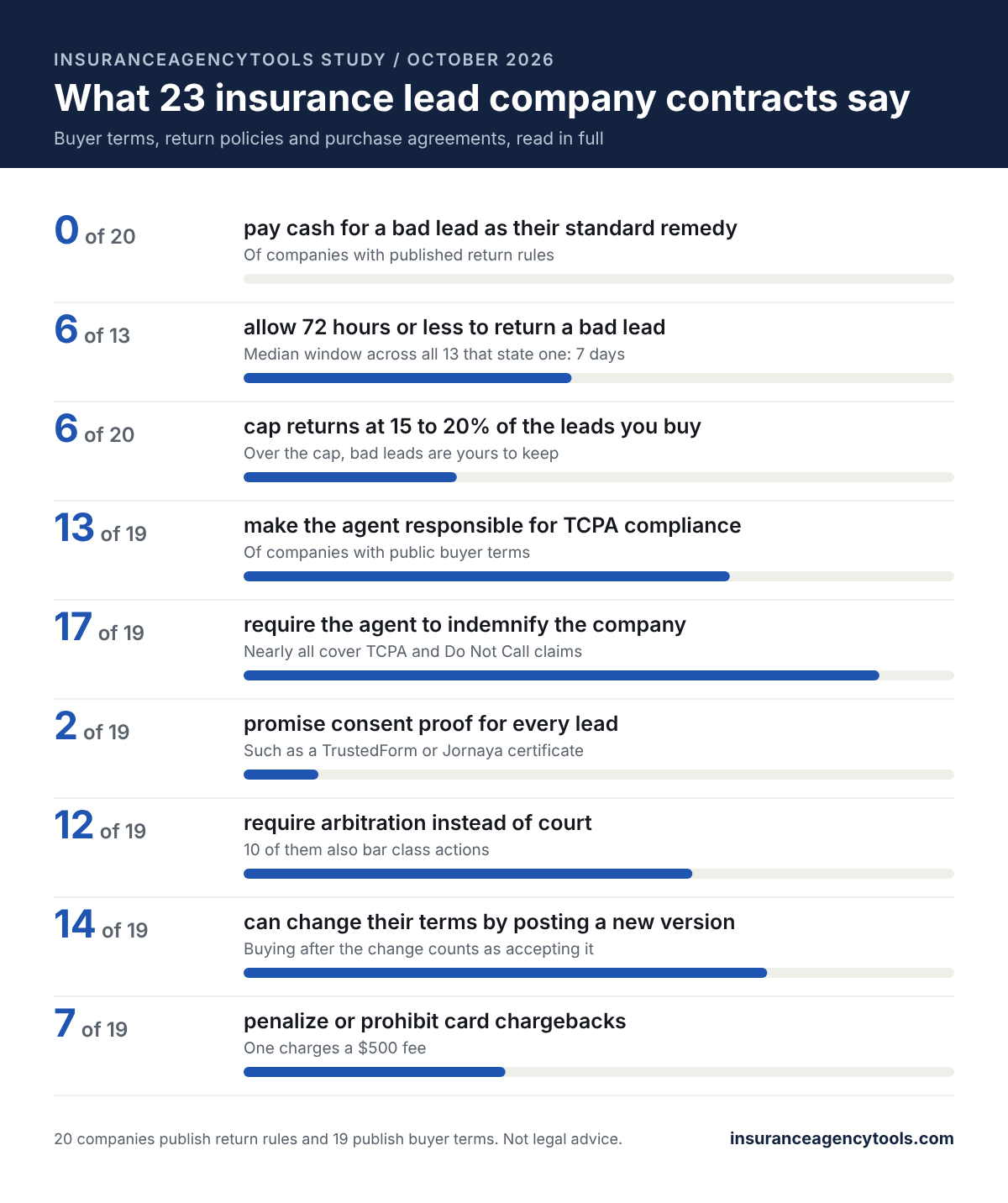
- No company pays cash for a bad lead as its standard remedy. Of the 20 companies that publish return rules, 18 give account credit or a replacement lead and two don’t take returns at all.
- Return windows are short. 13 companies state a window, the median is 7 days and six of them give you 72 hours or less.
- Six companies cap returns at 15% or 20% of the leads you buy.
- A lead that doesn’t answer isn’t a bad lead, at least not in these contracts. Every company that accepts returns credits only a closed list of reasons and none of them credits a lead because it didn’t convert.
- The calling compliance risk sits with the agent. 13 of the 19 companies with public buyer terms make the agent responsible for TCPA compliance and 17 require the agent to cover the company’s costs if a consumer sues over a call or text. Only two promise proof of consent for each lead.
- If something goes wrong there isn’t much to recover. 10 companies cap what they owe you at three months of fees or less, and 12 require arbitration, with 10 of those also barring class actions.
- Seven companies penalize card disputes, one of them with a $500 fee.
- 14 companies can change their terms just by posting a new version, and buying after the change counts as accepting it.
- Some contracts set a deadline for calling. Six companies keep ownership of the lead and license it to you for 30 days to three months, and two say outright that you have to stop calling and texting after 90 days.
Returns and refunds
Twenty of the 23 companies publish return or credit rules. Lead Heroes, QuoteWizard and Tivly don’t publish any.
| What you get for a bad lead | Companies |
|---|---|
| Account credit | 10 |
| A replacement lead | 6 |
| Credit or replacement, the company chooses | 2 |
| No returns | 2 |
| Cash refund as the standard remedy | 0 |
Cash does come back in some situations. Five companies say an unused prepaid balance is refundable: Centerfield, EverQuote, InsureLeads, MediaAlpha and Next Call Club. Eight say it isn’t.
| Return window | Companies |
|---|---|
| 48 hours | 2 |
| 72 hours | 4 |
| 7 days | 1 |
| 10 days | 5 |
| 30 days | 1 |
| No window stated | 7 |
Six companies cap returns. The cap is 20% at EverQuote, GOAT Leads, MediaAlpha, Speakeasy Leads and one aged-lead seller, and 15% at Centerfield. Speakeasy stops accepting any returns once your return rate passes 20% over a rolling 14 days. Six companies say in writing that a lead that doesn’t answer or goes to voicemail can’t be returned.
Billing
Twelve companies recharge your card automatically when your balance runs low, and one more implies it through a minimum balance rule. InsureLeads makes automatic reloads opt-in.
Four companies require a minimum commitment. Caboom Leads sells four-week and 12-week plans (three months for monthly annuity plans). GOAT Leads weekly plans are a four-week commitment. Next Call Club’s agreement runs one year and renews unless you give 30 days’ notice before the anniversary. Centerfield has a one-year term that renews automatically.
MediaAlpha charges an inactivity fee of 10% of your balance or $10 a month, whichever is greater, after 90 days without a purchase.
Calling compliance and consent
The Telephone Consumer Protection Act (TCPA) limits automated calls and texts to people who haven’t given consent. Lawsuits can cost far more than the leads.
| Who is responsible for TCPA compliance | Companies (of 19) |
|---|---|
| The agent | 13 |
| Shared, with the company warranting how it collected consent | 4 |
| Not addressed | 2 |
Seventeen of the 19 companies require the agent to indemnify the company, which means covering its costs if a claim arises. Nearly all of these clauses include TCPA and Do Not Call claims. Two of the 17 are mutual.
Only InsureLeads and GOAT Leads (where offered) promise consent proof for each lead in their terms. One aged-lead seller states that its leads were not gathered under “prior express written consent,” which the TCPA requires for automated calls and texts.
Disputes and liability
| How much the company can owe you | Companies (of 19) |
|---|---|
| One month of fees or less, or the single order | 3 |
| Three months of fees | 7 |
| Six months | 1 |
| 12 months | 3 |
| Everything you paid | 1 |
| Effectively nothing | 2 |
| No cap stated | 2 |
Twelve require arbitration instead of court and 10 of those also bar class actions. Eighteen sell leads “as is” with no promise about quality, contact or sales. Seven treat a chargeback through your card issuer as a breach of the agreement or charge a fee for it.
Exclusive, shared and who owns the lead
Only four companies state the most agents a shared lead can go to: three at EverQuote, four at MediaAlpha (you plus up to three others), four at Hometown Quotes and five at Benepath.
The contract can differ from the marketing. Benepath’s terms provide leads non-exclusively unless your order says otherwise. Caboom Leads moves exclusive leads into a shared pool after 30 days unless you mark them sold. Financialize can resell a lead after one year.
Six companies keep ownership of the lead and license it to you for a set period: SmartFinancial, Benepath, EverQuote and Next Call Club for 90 days, MediaAlpha for 30 days and one aged-lead seller for three months. Some of these spell out what the period means. EverQuote’s terms say the agent must stop calling or texting a lead 90 days after it was licensed, and Next Call Club’s say the agent may not contact a lead after 90 days. MediaAlpha’s 30-day license is to use the lead “by promptly contacting the consumer”. That aged-lead seller requires buyers to delete leads when the license ends. If a shopper is still in your follow-up when the period ends, check your seller’s terms before you keep calling.
Before you sign: five questions to ask
Get these answered before you fund the account, and if the rep will put the answers in an email so much the better.
- What’s the return window, and is there a cap on returns? A 48-hour window on a cap of 15% is a very different deal than 10 days with no cap.
- Do I get credit, a replacement or cash, and is my unused balance refundable? Most of the time it’s credit, so you want to know that going in.
- Can I get the consent record for each lead, and how fast? Delivered with the lead is what you’re hoping to hear.
- Who is responsible for TCPA compliance, and do I indemnify you? On most of these contracts the answer is you and yes.
- Is there a deadline for calling or texting the leads I buy? A few contracts have one and it’s easy to miss.
Method
We read the buyer-facing terms of service, purchase agreements, return or replacement policies and buyer FAQs published by each of the 23 lead companies listed on InsuranceAgencyTools, checked on October 6, 2026. We coded each document on 30 fields covering returns, billing, compliance, liability, disputes and lead ownership, and recorded the section for each finding.
Counts about returns use the 20 companies that publish return rules. Counts about contract terms use the 19 companies that publish buyer terms. AWL, Hometown Quotes, QuoteWizard and Tivly publish only consumer or general website terms. Financialize and OneLife Marketing Solutions publish general terms, but the agreements that govern purchases are provided privately. Where a company’s own documents disagreed, we used the most recent and noted the conflict.
This study describes what the documents say and should not be read as legal advice. A signed order or private agreement can change these terms for a given buyer.
More guides and research
- We fact-checked what AI tells agents about lead companies112 questions about 23 lead companies, four AI engines. 1 in 3 answers had at least one wrong fact in it.
- Consent questions to ask before you buy insurance leadsThe TCPA and consent questions to ask a lead seller before you call or text a single lead.
- How to test an insurance lead companyRun a small, fair test of two or three lead companies and compare them on cost per sale.
- Shared vs exclusive vs aged insurance leadsHow many agents get a shared lead, when exclusive stops being exclusive and what aged leads went through first.
- How we research and rankHow we research vendors, order our lists and keep pages current.